
Treat systems and features as development direction unless a later release announcement explicitly confirms them.
Somewhere beneath your feet is something valuable. The game does not tell you where it is.
MR POCKET — The Lost Vein is being developed as a persistent prospecting, exploration, discovery, mining, economic-strategy, and social world. It is not intended to be a small mobile gold-panning game, an arcade game wearing a prospecting skin, or a conventional mining simulator.
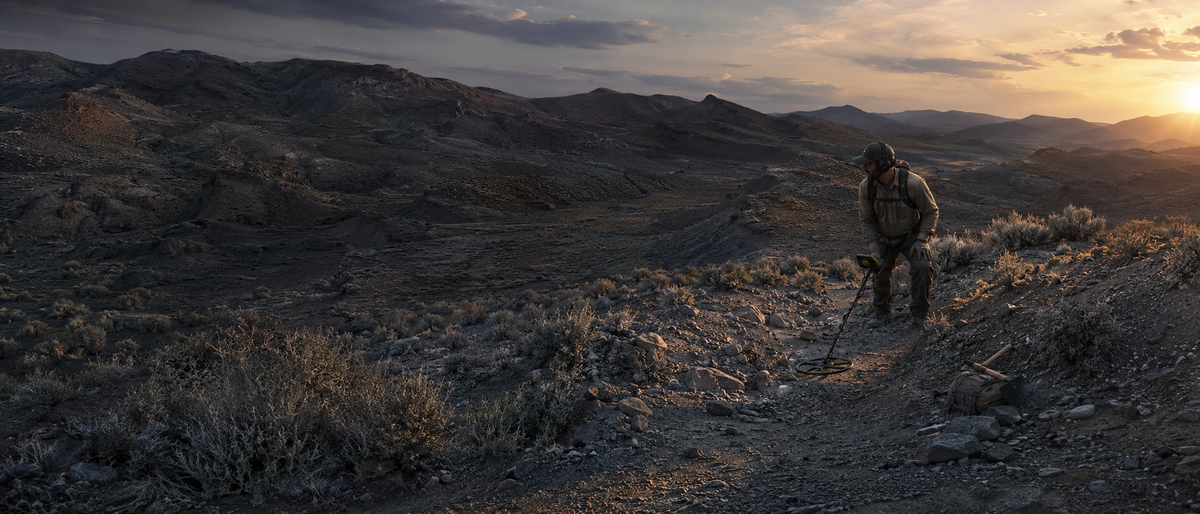
The fantasy begins with one person, one tool, very little money, and an enormous landscape full of evidence. Mountains rise in the distance. Old workings scar the ground. Dry washes disappear between ridges. Creeks cut ancient material. Tailings, benches, gullies, abandoned camps, and mineralized structures suggest stories about what happened before the player arrived.
Somewhere in that country may be fine placer gold, nuggets, specimens, old coins, relics, valuable artifacts, buried equipment, a structure worth developing—or absolutely nothing worth pursuing.
The ground holds the truth
The world does not exist simply as scenery. The ground itself is gameplay. Players learn to read terrain, geology, history, equipment feedback, and their own experience before deciding where to spend time and Credits.
The central question scales across the entire game: Do you believe the ground is worth pursuing?
A weak detector response asks it. A promising pan asks it. A geological anomaly asks it. A corporation deciding whether to sink a shaft asks the same thing—only now millions of Credits and major infrastructure may be at stake.
Metal detecting is an experience, not a loot button
The intended loop is physical and interpretive: sweep, hear or feel a signal, investigate, cross-sweep, interpret, pinpoint, dig, and reveal.
Detector behavior can respond to target depth, target size, conductivity, ground mineralization, sweep speed, consistency, coil choice, ground balance, sensitivity, detector configuration, interference, battery condition, and equipment wear. A questionable target may not give the player a clean answer. The player can shorten the sweep, approach from another direction, change settings, listen to the response, watch its behavior, and then decide whether to dig or leave.
Sometimes the ugly signal almost ignored is exactly the signal that should have been dug.
Equipment is not a level number
Different detector technologies have different personalities. Early VLF machines may be forgiving. High-frequency gold machines may excel at small gold while demanding more skill in difficult ground. Pulse-induction machines may excel in mineralization with different interpretation tradeoffs. More advanced equipment creates a higher skill ceiling; it does not remove the need to understand the machine.
Coils matter too. Small coils favor separation and precision. Standard coils balance coverage and control. Large coils offer more coverage and potential depth while becoming harder to interpret and pinpoint. Hardware changes belong in the player’s planning and logistics, not in a magic wilderness menu.
More than two professions
The long-term world is designed to support multiple legitimate careers: metal detecting, panning, dry washing, dredging, advanced surveying, multiple classes of ground-penetrating radar, surface exploration, claim development, property, underground mining, logistics, investment, and corporate-scale extraction.
A player does not need to become everything. Someone may become an exceptional detectorist. Another may obsess over placer recovery. Another may build a reputation around geological interpretation. Another may become a property owner, corporate organizer, or industrial mining operator.
The long-term progression fantasy is not a rigid class ladder. It is a possible life:
Prospector → Operator → Owner → Industrialist → Legend.
Sacred Empire
At the center of the world sits Sacred Empire, the institutional backbone for appraisal, purchasing, permits, records, leaderboards, historical achievement, corporate administration, and future economic services.
A significant discovery can be appraised. The player may sell it—or decide to keep it. Gold, nuggets, specimens, and important finds can live in a secure Vault separate from equipment storage. A personal history of discoveries should matter as much as the immediate sale price.
The eventual Sacred Empire Headquarters Compound is intended to become a destination in its own right: Monument Hall, Hall of Records, corporation recognition, live leaderboard installations, historical displays, and an informational museum that teaches the systems and history of the world.
When prospecting becomes industry
Corporations change the scale. A group of prospectors may eventually acquire operating rights, establish headquarters, survey targets, build infrastructure, develop deposits, sink shafts, advance headings, drill, blast, muck, haul, negotiate, compete, and leave permanent historical records.
Underground mining is not intended to become “buy mine, wait eight hours, collect money.” A corporation must interpret, commit capital, choose a development strategy, follow geological evidence, and sometimes discover that its theory was wrong.
There must be uncertainty without casino geology. The world has underlying deterministic truth. The players are trying to understand it.
Competition without griefing
The Lost Vein is intended to become social and competitive without becoming a full-loot punishment sandbox. Players may prospect together, join corporations, communicate, compare discoveries, participate in events, compete on leaderboards, race, duel, pursue contracts and permits, and build real rivalries.
But another player cannot murder a detectorist and steal a nugget, loot a backpack, destroy a house for entertainment, buy sabotage, or erase months of progress. Conflict should come from skill, economics, strategy, reputation, contracts, seasons, and structured competition.
The integrity of discovery
The commercial ecosystem may eventually support cosmetics, identity, property presentation, season content, memberships, collector editions, equipment appearance, corporate presentation, and personalization.
But a credit card must never become a better geological instrument. Real money cannot purchase richer ground, increased nugget probability, manipulated seeds, guaranteed rare finds, hidden detector accuracy, or exclusive domination of basic prospecting territory.
When a player finds something extraordinary, the honest reaction must be: I found that.
Built for mobile without shrinking the world
MR POCKET — The Lost Vein is being developed in Unity for Android and iPhone, with desktop planned as a future direction. The initial world architecture deliberately uses substantial region instances. This allows better mobile performance, higher visual quality, faster development, predictable memory usage, and cleaner deterministic generation.
The architecture is intended to remain streaming-ready. Regions can evolve toward streamed tiles and larger shared frontier spaces without replacing the underlying deterministic world model.
The moment everything serves
The player is alone in a wash. The sun is disappearing behind the mountains. The detector gives a barely repeatable response.
Stop. Sweep again. Nothing. Turn ninety degrees. Sweep. There it is—faint.
Reduce sensitivity. Ground balance. Sweep again. The signal cleans up. Kneel. Pinpoint. Move dirt. Check the hole. It is still there. Another handful. Now the target is out. A sharp response from the pile. Fingers move through the dirt.
Something catches the last light of the day.
That moment is MR POCKET — The Lost Vein. The economy, corporations, property, seasons, industrial mining, leaderboards, monuments, and social world exist to make that moment matter more.
Development status
The Lost Vein is in design and development. It is not yet released, and no release date, preorder, beta date, or final platform requirement has been announced. Systems, art, scope, multiplayer architecture, balance, commercial design, and release plans remain subject to prototyping, testing, and change.
It’s still out there. You have to go find it.